Graphic Bible · Scene 14 of 16
Historical Library · Extra-canonical text
1 Enoch 18
The selected Charles 1906 edited text and its POB working translation, not a new manuscript collation. Images are disclosed interpretations, not divine portraits, authenticated events or physical cosmology.
Source and translation notes
· Geʿez
Source edition: charles-1906-enoch
Selected edited-edition working text. Source review and these notes do not establish human-specialist, independent-manuscript or full-book certification. One or more source transcriptions retain POB editorial uncertainty marks, not ancient lacunae. Their exact spelling is not certified; the verse notes explain the provisional English meaning.
Chapter and verse addresses follow the supplied selected-edition POB records. Each available verse is displayed once; artwork does not certify source completeness.
- 18:1[a] Or treasuries. The source describes places where the winds are kept.
- 18:2[a] The printed Ge'ez has a singular stone of the corner; this revision does not silently pluralize it.
- 18:3[a] The verb describes extending or spreading out the height of heaven. The source then identifies the winds as heavenly pillars.
- 18:4[a] The rendering follows the Ge'ez causative wording. The facing Greek differs here; this is not a harmonized composite translation.
- 18:5[a] The selected Geʽez prints the corrupt bearing expression with †በደመናት, “in clouds,” leaving its object unclear. This English adopts the object “clouds” from the later Ethiopic variant reported by Charles, not from an invented missing object: printed48 note19 reports ደመናት without the preposition for t and β, and printed49 note6 describes the later reading as Greek-equivalent τὰς νεφέλας, “the clouds,” contrasting the best Ethiopic evidence. The printed singular bearing form and plural winds are also awkward. The selected source is preserved unchanged; the English is an explicit critical reading, not a claim that the best selected manuscripts all say “carrying the clouds.” I inspected Charles’s report, not those manuscripts themselves.
- 18:6[a] Charles encloses and I saw a place in parentheses and says in printed48 note27 that it is restored in accordance with the Greek. It is editorially restored wording in the selected edition, not independently established Ge'ez manuscript wording. The seventh mountain appears in verse8.
- 18:7[a] The Ge'ez mineral names are retained provisionally as colored, pearl, healing, and red stone. In particular, healing stone is not silently replaced with jasper from the facing Greek/editorial discussion; printed49 note13 calls the Greek stone-name wording corrupt.
- 18:8[a] Puk transliterates the uncertain printed stone name. The earlier English crystal is not established by this scan review; no precise mineral identification is claimed.
- 18:8[b] The first consonant of the word in this upper-part phrase is unclear in the selected photograph. POB marks that single source glyph with⟦?⟧; Charles did not print this marker. The earlier y-reading and a possible d-reading are not certified. Top or upper part is a provisional rendering supported by the actual Dillmann1865column1085 lexical entry, which includes a throne and cites18:8; that meaning does not settle the printed glyph. Sapphire remains in this phrase, not an invented foundation. No fresh manuscript collation or all-glyph resolution is claimed.
- 18:9[a] The selected daggered clause literally has “and what was within all the mountains,” retained here as a second object of seeing. It is readable as a diplomatic construction but not certified as the earlier meaning. Charles printed48 note51, continued on49, identifies it as a corrupt rendering of the Greek κἀπέκεινα τῶν ὀρέων τούτων, “and beyond these mountains,” and calls “all” corrupt for “these.” That Greek location phrase also leads into the place description of18:10. This English does not silently replace within with beyond or all with these, or force the location phrase to modify the fire. The printed Greek is comparison evidence, not a newly collated manuscript.
- 18:10[a] Charles puts and I saw there in square brackets; printed49 note52 describes it as an addition in Ethiopic. It is retained as printed, not called an independent Greek reading or an editorial restoration.
- 18:10[b] The printed Ge'ez word rendered beyond is marked corrupt. Printed49 note54 compares a Greek beyond-form with an end-form. This translation follows the printed Ge'ez surface reading; it does not settle the underlying textual problem.
- 18:10[c] The subject heavens continues at the start of printed50/PDF88. The old verse stopped before this word, leaving an unsupported they. Printed49 note56 also questions the Ge'ez rendering against the Greek; the gathering verb is retained as printed.
- 18:11[a] The printed clause speaks of descending columns with no number and directions above and below. This is not emended to a statement that the chasm cannot be measured in height or depth. Charles records variants in printed50 notes3-12.
- 18:12[a] Beyond renders the contextual direction; the printed Ge’ez preposition is literally on/upon. Charles calls it a wrong rendering of the Greek beyond in printed50 note13. This follows that disclosed editorial explanation, not an independently collated Greek manuscript.
- 18:12[b] The selected print has the marked negativeኢ before the heaven-covering verb. Charles’s printed50 note14 records its omission by witnessq; this translation retains the selected negative rather than silently changing it to a positive.
- 18:12[c] The selected main printing hasማን, ending with the nun-shaped letterን, not the ordinary finalይ of the water-word. This source record preserves that anomalous printing. English water follows the water-reading reported in Charles’s printed50 note17; Dillmann’s1865 lexicon,column212,gives aqua for the water-word. Whether the main printed anomaly is a typesetting error or reflects an antecedent cannot be established from these images. The apparatus reports manuscript readings; those manuscripts were not independently inspected here.
- 18:13[a] The selected final Geʽez clause is daggered and corrupt, approximately “and like a spirit that asks me,” with the direction of inquiry distorted. The English inquiry about the stars adopts Charles’s printed Greek περὶ ὧν πυνθανομένῳ μοι, “as I inquired about them.” His printed50 note24 and printed51 note5 explicitly compare the corrupt Geʽez with this inquiry construction. The Greek links the inquiry to the angel’s reply in18:14; English coordinates “I asked” for a readable verse without adding the reply here. This is an openly Greek-assisted critical treatment, not a claim that the selected Geʽez spirit-asks-me clause is sound or that a Greek manuscript was independently collated.
- 18:15[a] The phrase before their dawn preserves the surface Ge'ez temporal wording. A first-rising interpretation is possible but not silently substituted here.
- 18:16[a] The selected ending literally has “in a year of mystery,” with “mystery” daggered. Dillmann1865 col181 confirms the mystery/secret word and explicitly cites18:16; it does not mean ten thousand. For the duration this English adopts Charles’s printed Greek ἐνιαυτῶν μυρίων, ten thousand years. Printed50 note36 and printed51 note9 identify the Geʽez ending as corrupt and distinguish Greek years/myriad from year/mystery. The duration therefore comes from the explicitly identified edited Greek parallel, not from silently changing a Geʽez numeral, lexicalizing mystery as a number, or claiming fresh manuscript evidence. “Sin” retains the selected noun rather than replacing it with an unmarked word for punishment.
1 Enoch 18:14
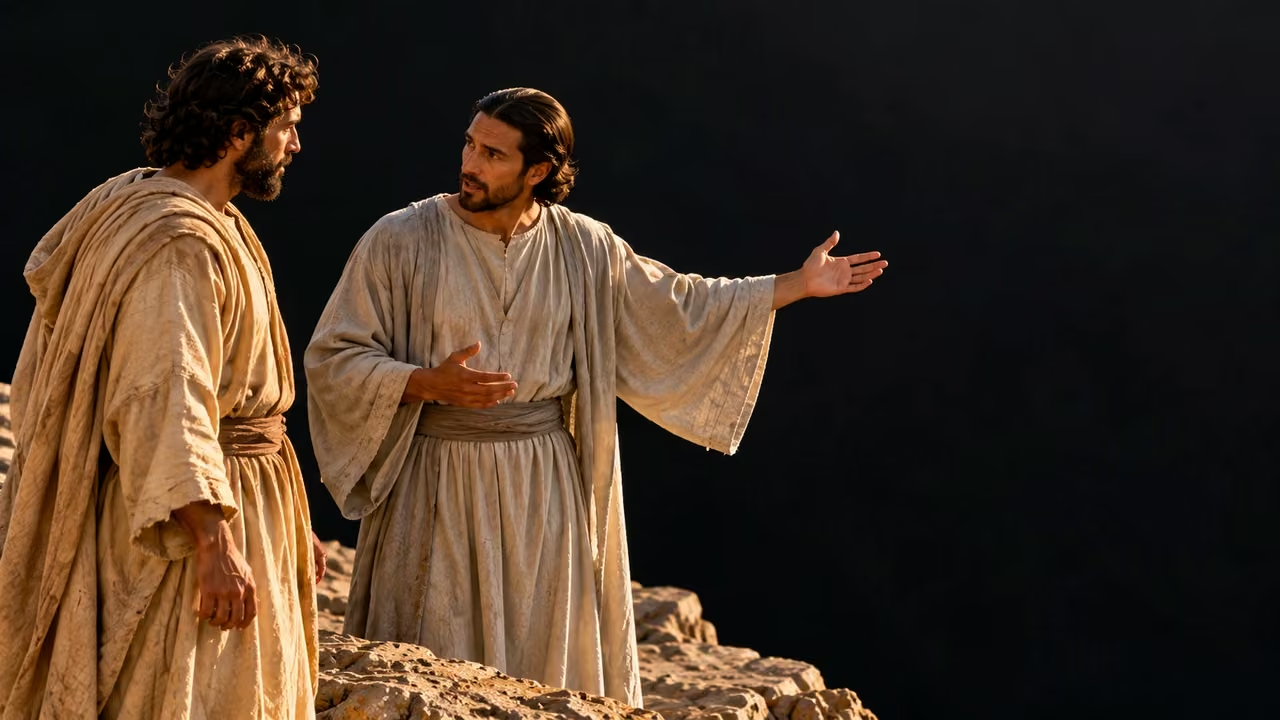
The Angel Explains
Winds, Mountains and the Seven Stars · 1 Enoch 18
Story guide: An unnamed angel points toward the distant stars while explaining the place to the attentive traveler.
Open this scene in the reader →14The angel said, “This is the place of the end of heaven and earth; this has become a prison for the stars and the host of heaven.”
Step through the story beside the Scripture itself. About the People’s Open Bible