Graphic Bible · Scene 3 of 4
Historical Library · Extra-canonical text
1 Enoch 70
The selected Charles 1906 edited text and its POB working translation, not a new manuscript collation. Images are disclosed interpretations, not divine portraits, authenticated events or physical cosmology.
Source and translation notes
· Geʿez
Source edition: charles-1906-enoch
Selected edited-edition working text. Source review and these notes do not establish human-specialist, independent-manuscript or full-book certification.
Chapter and verse addresses follow the supplied selected-edition POB records. Each available verse is displayed once; artwork does not certify source completeness.
- 70:1[a] The selected wording is compressed: his name, living, followed by before/in his presence and to that Son of Man. The pronoun’s referent and the precise relation of living are not supplied by a new identity claim. Son of Man renders the extended human idiom in the printed Ge’ez. The third-person wording here and in verse2 is retained rather than harmonized to the first person of verse3.
- 70:2[a] Or chariots of wind. The noun can denote spirit or wind; this phrase does not explicitly name the Holy Spirit. Dillmann1865 columns347-348 gives the vehicle/chariot noun, including plural forms that can also be used collectively.
- 70:2[b] The selected print has name without an attached possessive suffix. Went out among them preserves the movement expression without silently replacing it with disappeared or adding a missing possessive.
- 70:3[a] The printed verb is reckoned/counted, supported by Dillmann1865 column91. Charles printed128 note4 records forms for being drawn/brought; the English does not substitute those readings for the selected verb. The printed shift to first-person I/me is retained.
- 70:3[b] Dillmann1865 columns708-709 supports wind for this noun and cites70:3; column180 gives north forመስዕ and column964 west forዐረብ. The repeated between construction is retained without pretending its spatial detail is more precise than the text.
- 70:3[c] Dillmann1865 column100 explicitly cites70:3 under measuring cords. The selected source includes for me followed by a place for the chosen and righteous; neither phrase is silently omitted.
- 70:4[a] Or from eternity. The expression is retained as an indefinite ancient duration, not expanded into a more specific chronology or doctrine of personal preexistence.
1 Enoch 70:3
Between the Winds and the Measuring Cords
A Name Raised and a Place Measured · 1 Enoch 70
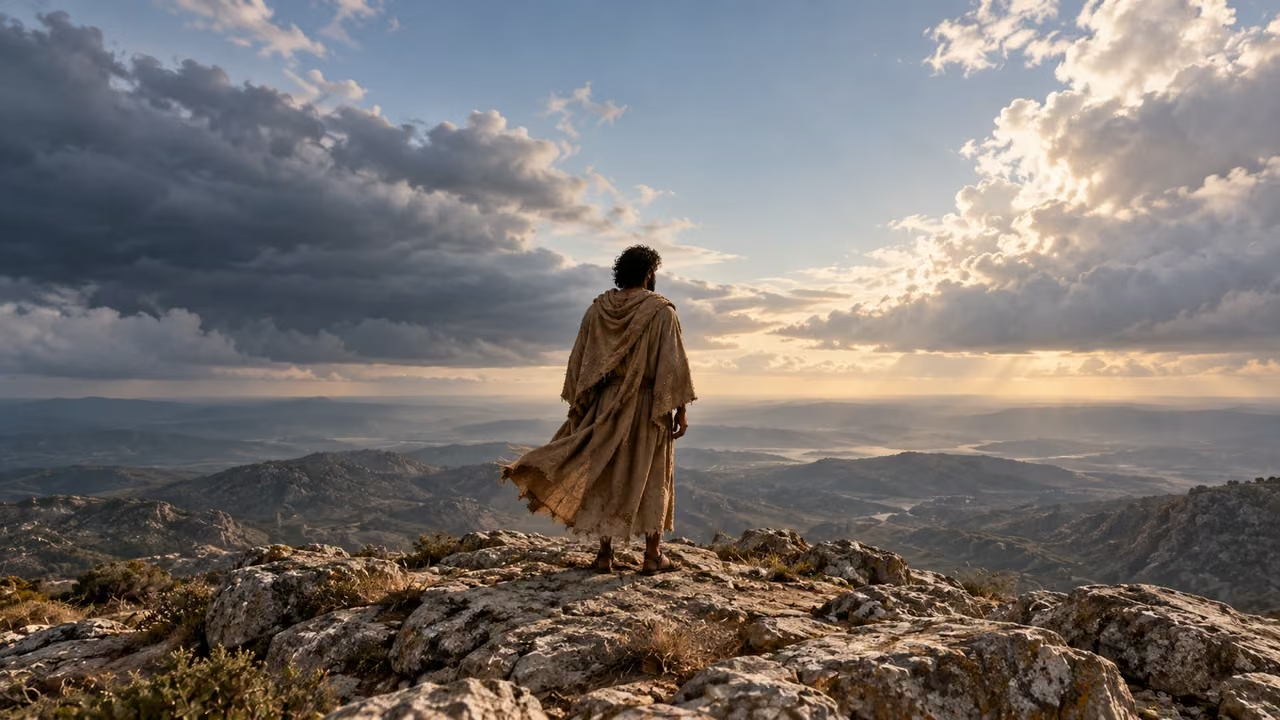
Story guide: Cloud layers interpret between-the-winds language without a precision map. Anonymous veiled messengers illustrate measuring cords, not known anatomy or exact dimensions; the counting verb and first-person shift stay intact.
Open this scene in the reader →3From that day I was not reckoned among them. He placed me between the two winds, between the north and the west, where the angels took cords to measure out for me a place for the chosen and righteous.
Step through the story beside the Scripture itself. About the People’s Open Bible