Graphic Bible · Scene 1 of 4
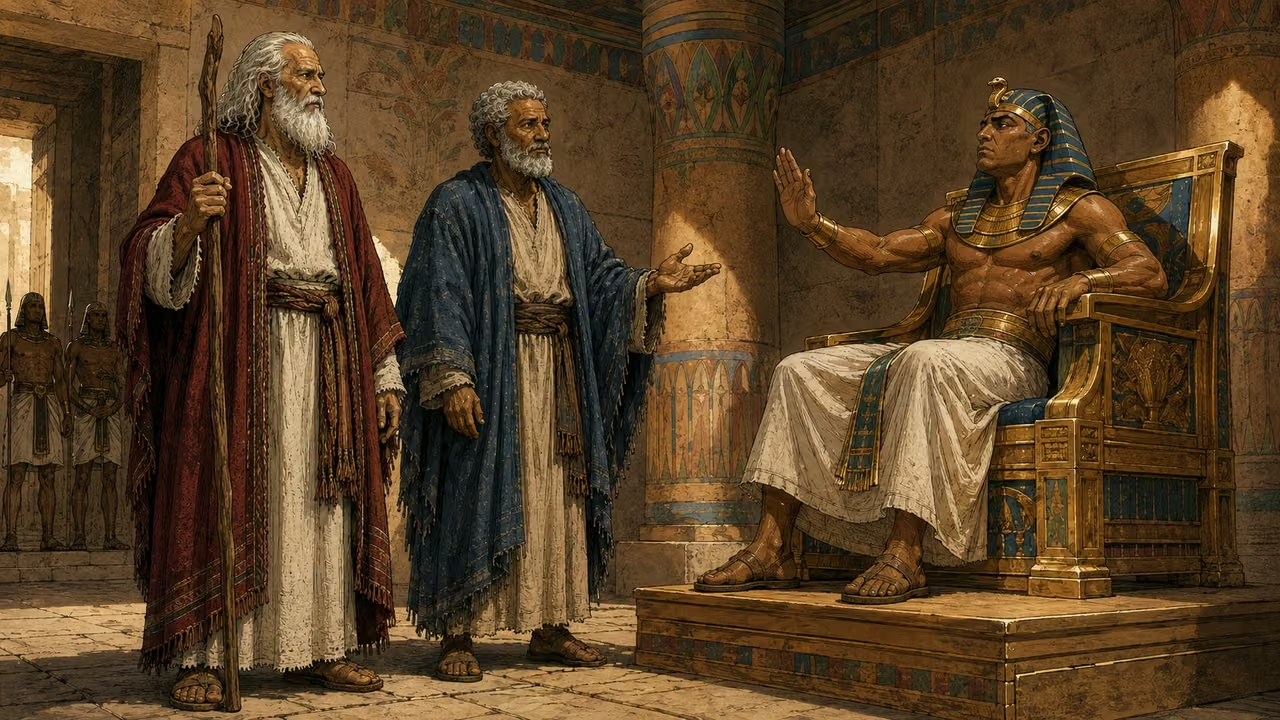
Exodus 5:1-5. Before Pharaoh. Moses and Aaron stand before Pharaoh in a restrained Egyptian audience hall. Three central characters: Moses at left in crimson mantle, long white hair and beard with gnarled staff; Aaron beside him in dusty indigo, short silver-gray curls and rounded beard, calmly addressing the king; Pharaoh at right seated rigidly on a low-backed gilded wood throne on a shallow raised platform, wearing his blue/gold nemes and white linen. Match each person only to his corresponding reference. Pharaoh turns a dismissive open palm toward them, refusal conveyed by posture. Painted plaster walls, simple lotus-form columns, stone floor, warm daylight from high openings, deep shadows. Two small distant guards may stand at the doorway without distracting. No miracle, snake, burning bush, deity, Roman columns or modern architecture. One coherent wide 16:9 scene, no text. Bronze Age Exodus setting, not first-century staging. One 16:9 single scene. No text or lettering.
Artwork is an interpretation. Scripture is quoted from the People's Open Bible.

Exodus 5:1-5

Before Pharaoh

Story guide: Moses and Aaron ask Pharaoh to let the people go; he refuses.

Open this scene in the reader →

1Afterward Moses and Aaron went in and said to Pharaoh, “Thus says Yahweh, the God of Israel: Let my people go, so that they may hold a feast to me in the wilderness.”

2Pharaoh said, “Who is Yahweh, that I should obey his voice and let Israel go? I do not know Yahweh, and moreover I will not let Israel go.”

3And they said, “The God of the Hebrews has met with us. Please let us go a journey of three days into the wilderness, so that we may sacrifice to Yahweh our God, lest he strike us with plague or with the sword.”

4But the king of Egypt said to them, “Why, Moses and Aaron, are you causing the people to neglect their work? Go to your burdens.”

5Pharaoh said, “Look, the people of the land are now many, and you are making them rest from their burdens.”

Step through the story beside the Scripture itself. About the People’s Open Bible