Graphic Bible · Scene 21 of 22
Historical Library · Deuterocanonical Literature
Tobit 1
POB Greek working edition anchored in Swete (1909), retaining its declared local longer-form selection at 6:3–6. Artwork depicts events, reported memories and prayers as this edition presents them.
Source and translation notes
The edition opens with the book of the words of Tobit. The artwork does not authenticate portraits or authorship.
· Greek
Source edition: Available POB working translation anchored in Swete 1909 Greek, with a declared local Sinaiticus-form selection at Tobit 6:3–6 applied 2026-10-04. This is an eclectic working book, not a continuous Sinaiticus edition or a newly established critical text. Pinned revision: 0aa3e29d92329a4f9420c88f0fcf20ba48e76757
Chapter and verse numbers follow the available POB edition, including its supplied gaps. Source records are displayed once in their supplied order; missing numbers are not reconstructed.
- Tobit 1:1[a] Greek has 'book of the words,' a formal title-like expression. It could also be rendered 'record' or 'account.'
- Tobit 1:1[b] The ancestor's name appears in a difficult Greek form here; the English normalizes it as 'Gabael.' Some witnesses and secondary traditions reflect forms closer to 'Gabiel' or 'Bagabael.'
- Tobit 1:2[a] The place names in this verse are difficult and may reflect textual or geographic uncertainty. 'Kydios' may represent a site otherwise identified differently, and 'to the right of' / 'above Asher' are kept relatively literal rather than converted into a more interpretive compass direction.
- Tobit 1:2[b] Some interpreters identify 'Enemessaros' with the Assyrian king Shalmaneser, but the Greek text here reads the transliterated form 'Enemessaros.'
- Tobit 1:3[a] Or 'I gave much alms.' The Greek expression can refer specifically to almsgiving, though here it may also include broader deeds of mercy.
- Tobit 1:3[b] 'My brothers' likely refers to Tobit's fellow Israelites or kinsmen more broadly, not only male siblings.
- Tobit 1:4[a] The Greek text here distinguishes 'the house of Jerusalem' from 'the temple'; the first likely refers broadly to the Jerusalem sanctuary, while the second names the temple more specifically.
- Tobit 1:4[b] The final Greek words are textually difficult, ending with 'for all' (εἰς πάσας). The translation supplies 'for all generations' to make coherent sense of the clause; compare the longer Tobit tradition, which supports an enduring, generational reference.
- Tobit 1:4[c] Qumran Tobit fragments are known to align more often with the longer Greek tradition in this book, though this verse here is translated from Swete's Greek witness.
- Tobit 1:5[a] Or 'Baal the calf.' The Greek uses a word for a young cow/heifer; the phrase likely refers to the bovine cult image associated with northern Israel's worship.
- Tobit 1:5[b] The Greek syntax at the end is compressed: literally, 'and the house of Naphtali of my father.' The sense is that even Tobit's own ancestral house was included among those participating.
- Tobit 1:6[a] Or 'in Jerusalem'; the Greek uses 'in Jerusalem' with a verb of travel, but English normally says 'go to Jerusalem.'
- Tobit 1:6[b] The rare Greek term rendered 'first shearings' likely refers to the first portion from shearing livestock; some take it more generally as first pastoral dues.
- Tobit 1:7[a] Or, more idiomatically, 'the tithe' and 'the second tithe.' The Greek reads literally 'the tenth' and 'the second tenth.'
- Tobit 1:7[b] The verb rendered 'I would sell' can also be understood as converting the second tenth into money before going to Jerusalem to spend it there.
- Tobit 1:8[a] Or, more explicitly, 'the third portion' or 'a third part'; the Greek leaves the noun implied from the context.
- Tobit 1:8[b] Literally, 'my father's mother.'
- Tobit 1:8[c] That is, effectively 'fatherless'; the Greek reads literally, 'I was left an orphan by my father,' referring to the loss of his father.
- Tobit 1:9[a] Or, more smoothly, 'from the lineage of our father's family.' The Greek literally says 'from the seed of our father's family,' emphasizing descent within the paternal line.
- Tobit 1:9[b] Traditional English often has 'Tobias' here; the Greek name is rendered more directly as 'Tobiah.'
- Tobit 1:10[a] Or 'the food of the Gentiles.' The Greek says literally 'the breads of the Gentiles,' an idiom for food provisions.
- Tobit 1:11[a] Greek literally, 'I guarded my soul not to eat.' Here 'my soul' functions idiomatically for 'myself.'
- Tobit 1:11[b] The surviving Greek here is brief and appears to continue into the next clause; the sense is Tobit's deliberate refusal to eat.
- Tobit 1:12[a] Or “with all my soul.”
- Tobit 1:13[a] Or 'favor and comeliness' / 'favor and good standing.' The Greek μορφή can denote outward form or appearance, and the exact nuance in this court context is not fully certain.
- Tobit 1:13[b] Or 'his purchasing agent.' The Greek literally says 'buyer,' likely referring to an official responsible for procurement.
- Tobit 1:14[a] Or 'I went to Media'; the Greek imperfect verb can suggest repeated/customary action ('I used to go') rather than a single journey.
- Tobit 1:14[b] Or 'I entrusted' ten talents of silver to Gabael. The Greek verb can denote placing something in another's care, here in a financial sense.
- Tobit 1:14[c] The Greek place name may also be rendered 'Rhages of Media.'
- Tobit 1:15[a] The Greek verb rendered 'became unsafe' is difficult and appears in an unusual form; the sense is inferred from the travel context: the routes were in disorder or insecure, so Tobit could no longer travel to Media.
- Tobit 1:15[b] The royal names appear here as Enemessar and Achreil in the Greek witness used for this translation; other textual traditions of Tobit preserve different spellings and, in some cases, different names.
- Tobit 1:16[a] Or 'alms' or 'charitable deeds'; the Greek term often refers to concrete acts of mercy, especially giving to the needy.
- Tobit 1:16[b] 'My brothers' may refer broadly to Tobit's fellow Israelites or kinsmen, not only to biological brothers.
- Tobit 1:17[a] Or 'outside the wall of Nineveh.' The Greek says 'behind the wall of Nineveh,' which may describe bodies cast beyond the city wall.
- Tobit 1:18[a] Greek Swete reads 'Achreil the king' (Ἀχρειλ ὁ βασιλεύς), a form understood in context to refer to Sennacherib.
- Tobit 1:19[a] Or, 'one of those in Nineveh.' The Greek expression is literally 'one of those in Nineveh.'
- Tobit 1:19[b] Or, 'they were seeking to kill me.' The Greek more literally says, 'I was being sought to be put to death.'
- Tobit 1:20[a] Greek: 'nothing was left to me except Anna my wife and Tobit my son.' The verse speaks of what remained to Tobit after his goods were taken; it does not imply that his wife and son were possessions.
- Tobit 1:21[a] Sacherdonos is the Greek form of the Assyrian royal name more commonly rendered in English as Esarhaddon.
- Tobit 1:21[b] Achiacharos is the Greek form of the name often rendered Ahikar.
- Tobit 1:22[a] Greek literally, 'appointed him son of the second,' an idiomatic and textually awkward expression commonly understood to mean that Ahiacharus held the position next after the king or was second in rank.
Tobit 1:21
A death, a flight and an appointment
Mercy, exile and a dangerous return · Tobit 1
Story guide: Two sons flee after killing the king, and Achiacharus receives authority over the kingdom’s accounts under the new reign.
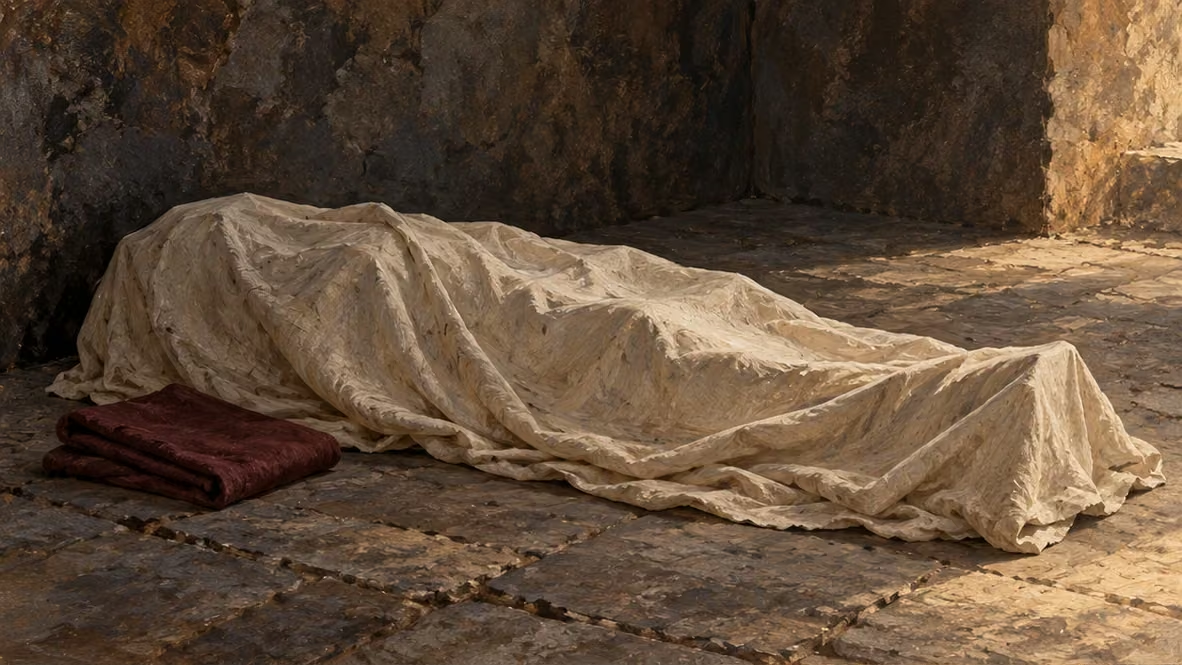
Open this scene in the reader →21And before fifty days had passed, his two sons killed him and fled to the mountains of Ararat. And Sacherdonos his son reigned in his place, and he appointed Achiacharos, the son of Anael, my brother's son, over all the accounts of his kingdom and over the whole administration.
Step through the story beside the Scripture itself. About the People’s Open Bible