Graphic Bible · Scene 14 of 18
Historical Library · Deuterocanonical Literature
Tobit 13
POB Greek working edition anchored in Swete (1909), retaining its declared local longer-form selection at 6:3–6. Artwork depicts events, reported memories and prayers as this edition presents them.
Source and translation notes
The edition opens with the book of the words of Tobit. The artwork does not authenticate portraits or authorship.
· Greek
Source edition: Available POB working translation anchored in Swete 1909 Greek, with a declared local Sinaiticus-form selection at Tobit 6:3–6 applied 2026-10-04. This is an eclectic working book, not a continuous Sinaiticus edition or a newly established critical text. Pinned revision: 0aa3e29d92329a4f9420c88f0fcf20ba48e76757
Chapter and verse numbers follow the available POB edition, including its supplied gaps. Source records are displayed once in their supplied order; missing numbers are not reconstructed.
- Tobit 13:1[a] The Greek text ends abruptly with 'and his kingdom.' Some translators supply an implied predicate such as 'is blessed' or connect the phrase with 'forever.' The concise wording is retained here to avoid adding what the source does not explicitly say.
- Tobit 13:2[a] Or 'to the grave' or 'to the realm of the dead.' Greek: 'to Hades.'
- Tobit 13:3[a] Or 'Confess him' or 'Praise him'; the Greek verb can carry a range of senses including acknowledgment, thanksgiving, and praise.
- Tobit 13:4[a] Or 'show his majesty' for 'declare his greatness.' The Greek verb can mean 'show' or 'make known,' and the noun can also be rendered 'majesty.'
- Tobit 13:4[b] Greek literally, 'before every living [one].' The phrase is broad, though in context it most naturally refers to all living people.
- Tobit 13:4[c] Or 'for all the ages.' The Greek expression emphasizes unending duration.
- Tobit 13:5[a] Greek shifts from 'us/our' to 'you were scattered' in the last clause; some English translations smooth this to 'we were scattered,' but the source text's change in person is preserved here.
- Tobit 13:6[a] Or 'to act faithfully before him.' The Greek literally says 'to do truth' before him, a Semitic-style expression for living truthfully or faithfully in God's sight.
- Tobit 13:6[b] Or 'with all your body.' The Greek reads literally 'with your whole body,' likely expressing wholehearted, embodied thanksgiving.
- Tobit 13:6[c] Or 'the Lord of justice.'
- Tobit 13:6[d] Or 'the eternal King.'
- Tobit 13:7[a] The Greek middle clause is elliptical: literally, 'and my soul to the King of heaven.' The translation supplies 'rejoices in' to express the likely poetic sense in context.
- Tobit 13:8[a] Or 'confess to him' or 'praise him'; the Greek verb can carry any of these worship-related senses depending on context.
- Tobit 13:9[a] Or 'city of the holy one'; the Greek genitive may be taken more generally, but in context it most likely refers to God.
- Tobit 13:9[b] Greek 'sons' in both phrases; rendered 'children' here because the sense is collective.
- Tobit 13:11[a] Or 'generation after generation will bring you rejoicing.' The Greek literally reads 'generations of generations will give you exultation.'
- Tobit 13:13[a] Or 'the children of the righteous.' The Greek says 'sons,' which may refer more broadly to descendants.
- Tobit 13:14[a] Or 'your scourgings,' 'your plagues,' or 'your chastisements' for 'your afflictions.' The Greek μάστιξ can refer literally to a whip or figuratively to strokes of suffering.
- Tobit 13:16[a] Or 'will be rebuilt'; the Greek says simply 'will be built,' but the restoration context can suggest rebuilding.
- Tobit 13:16[b] The Greek addresses Jerusalem directly: 'your walls.'
- Tobit 13:16[c] 'Battlements' translates a term for defensive fortifications; 'bulwarks' or 'ramparts' are also possible.
- Tobit 13:17[a] Or 'stones of Ophir,' if Σουφείρ is understood as the place-name Ophir rather than transliterated directly from the Greek witness.
- Tobit 13:18[a] Or, more idiomatically, 'who is exalted forever' or 'throughout all ages.' The Greek reads literally 'who has exalted all the ages,' an unusual expression.
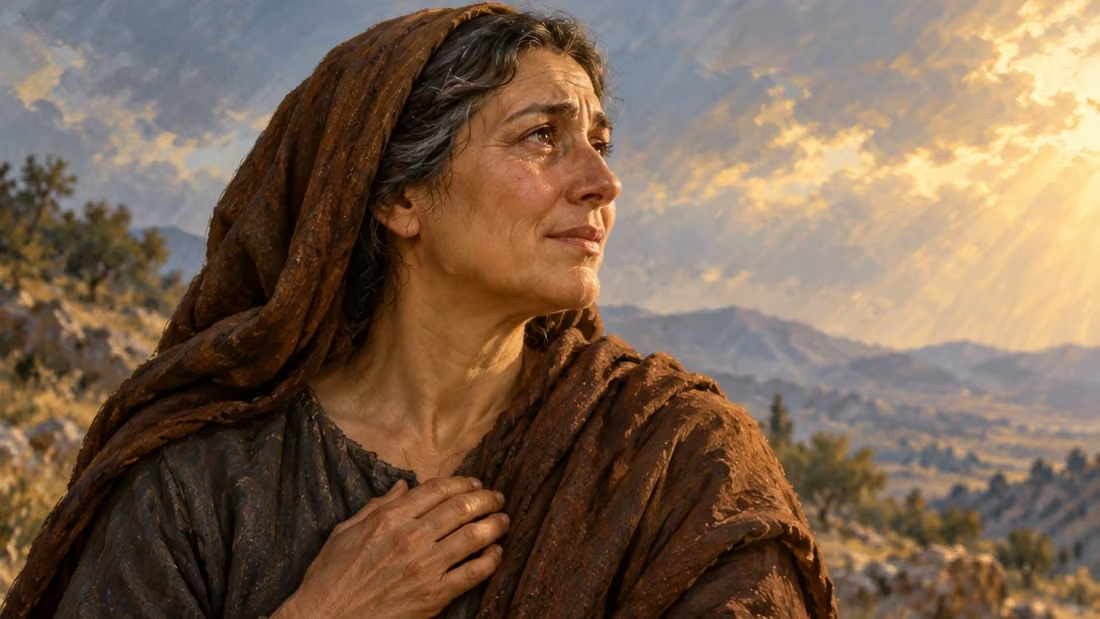
Tobit 13:14
Joy over peace
A prayer for mercy and Jerusalem · Tobit 13
Story guide: A grieving figure turns toward peace as the prayer promises joy to those who mourned Jerusalem’s affliction.
Open this scene in the reader →14Oh, blessed are those who love you; they will rejoice over your peace. Blessed are all who were grieved over your afflictions, because they will rejoice over you when they see all your glory; and my soul will rejoice forever.
Step through the story beside the Scripture itself. About the People’s Open Bible