Graphic Bible · Scene 6 of 15
Historical Library · Deuterocanonical Literature
Tobit 14
POB Greek working edition anchored in Swete (1909), retaining its declared local longer-form selection at 6:3–6. Artwork depicts events, reported memories and prayers as this edition presents them.
Source and translation notes
The edition opens with the book of the words of Tobit. The artwork does not authenticate portraits or authorship.
· Greek
Source edition: Available POB working translation anchored in Swete 1909 Greek, with a declared local Sinaiticus-form selection at Tobit 6:3–6 applied 2026-10-04. This is an eclectic working book, not a continuous Sinaiticus edition or a newly established critical text. Pinned revision: 0aa3e29d92329a4f9420c88f0fcf20ba48e76757
Chapter and verse numbers follow the available POB edition, including its supplied gaps. Source records are displayed once in their supplied order; missing numbers are not reconstructed.
- Tobit 14:1[a] Or 'stopped confessing' if ἐξομολογούμενος is taken in its penitential sense; here the context favors praise or thanksgiving.
- Tobit 14:2[a] Greek literally, 'he lost the sights' and later 'looked up/saw again,' an idiom for losing and recovering sight.
- Tobit 14:2[b] Or 'he gave alms'; the Greek term can refer specifically to almsgiving or more broadly to deeds of mercy.
- Tobit 14:2[c] The Greek says only 'continued to fear'; 'God' is implied by the pious context and supplied for clear English.
- Tobit 14:3[a] Or, more literally, “his son and his son's sons”; that is, his son and grandsons.
- Tobit 14:3[b] The Greek says, more literally, “I am toward departing from living,” an idiomatic way of saying that death is near.
- Tobit 14:4[a] Or, 'there will be rather more peace until a season.' The Greek includes a comparative term that may suggest relative safety in Media rather than absolute peace.
- Tobit 14:4[b] 'The house of God' refers to the temple in Jerusalem.
- Tobit 14:5[a] Or 'from exile.' The Greek has the plural 'from the captivities,' which may point to multiple places or episodes of exile.
- Tobit 14:5[b] 'The times of the age' is an idiomatic phrase that may refer to appointed times leading up to God's fuller restoration; the Greek is left intentionally open here.
- Tobit 14:5[c] Jerusalem is referred to with feminine pronouns in Greek: 'in her' and 'concerning her.'
- Tobit 14:6[a] Or 'will truly return to fear the Lord God.' The Greek verb can mean 'turn' or 'return,' here expressing the nations' sincere turning toward God.
- Tobit 14:7[a] Or 'will confess God' or 'will praise God'; the Greek verb can carry senses of confession or thanksgiving/praise depending on context.
- Tobit 14:7[b] 'Righteousness' could also be rendered 'justice,' though here the sense is likely uprightness in devotion and conduct.
- Tobit 14:7[c] Greek 'our brothers'; the term may function representatively for one's fellow kin or community members.
- Tobit 14:8[a] Or 'son' for 'child'; the Greek τέκνον is a filial term of address and can be rendered either way depending on context.
- Tobit 14:10[a] Greek Ἀδὰμ here is the personal name of the treacherous courtier in the Ahikar story, not the first man Adam. The name is rendered 'Nadab' to avoid confusion; 'Adam' is a more literal transliteration of the Greek form.
- Tobit 14:10[b] Or 'almsgiving' for 'acts of mercy'; the Greek term ἐλεημοσύνη often refers specifically to charitable giving in Tobit.
- Tobit 14:11[a] Or 'justice delivers.' The Greek word can denote either righteousness or justice depending on context.
- Tobit 14:11[b] Literally, 'his soul failed/left him.' This is a Greek idiom for death.
- Tobit 14:11[c] Some readers may expect 'they buried him honorably,' but the Greek witness here has a singular verb: 'he buried him honorably.'
- Tobit 14:12[a] Greek: 'he buried her with his father.' The implied subject is not stated in that clause; the next clause explicitly names Tobit/Tobias in Greek.
- Tobit 14:13[a] Or, more literally, 'he buried his parents-in-law gloriously/splendidly'; here the sense is taken as an honorable burial rather than display.
- Tobit 14:15[a] Greek: 'which Nebuchadnezzar and Ahasuerus had taken captive.' The wording is retained as found in the source text, though interpreters debate the historical identification of these rulers in relation to Nineveh's fall.
Tobit 14:6
The nations will turn
Final counsel and an honorable old age · Tobit 14
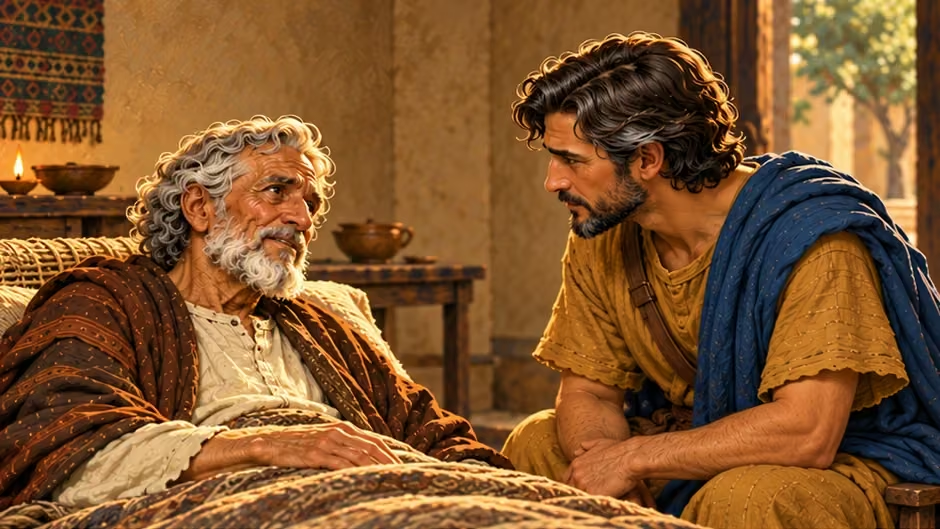
Story guide: Father and son remain in quiet counsel as Tobit foresees the nations turning to God and burying their idols.
Open this scene in the reader →6And all the nations will truly turn to fear the Lord God; they will bury their idols.
Step through the story beside the Scripture itself. About the People’s Open Bible